Imagine Otherwise: Science of Creative Wellbeing | Dr. Tasha Golden
Dr. Tasha Golden offers a transformative framework for creative wellbeing that invites us to see the world as reconfigurable, navigate the tension between what is and what could be, and cultivate wonder as a daily practice of resistance and possibility.
"You need not take or leave the world as it was when you came in." James Baldwin's words echo with a profound challenge: the world can be different, and we have a role in shaping it. But how do we cultivate the creative capacity to imagine and build that different world? Dr. Tasha Golden, a researcher specializing in creativity and wellbeing, offers a framework that begins with a fundamental shift in perspective.
-
I don't often think of people as greedy anymore, so much as uncreative. They can't imagine a different way of being or creating. Yeah, they can't imagine otherwise. Instead of asking, how can I get more, ask the question, how can I imagine otherwise? When we truly embrace our kind of individual and collective ability to imagine that it can be otherwise, that is where we begin a greater collective creativity toward better.
communities, a better world, better systems, better experience of the human life. That's possible.
MAGICademy Podcast (00:30)
I was just listening to a song called You Did Everything Right.
It's a song by the band called The Ellery a very popular band touring around the world featured on Fox, ABC, Showtime, Netflix.
However, one day the band came into a harsh stop because the lead singer and songwriter went into a dark space filled with burnout and depression. And walking out of that dark space, she was guided by the calling to investigate how can modern science
and art inform us as human beings to live in a more harmonized and well-lived life.
And now she emerges as Dr. Tasha Golden in the forefront of art, creativity, innovation, change, and wellbeing. She is the first director of the International Arts and Mind Lab at Johns Hopkins.
She is also a leading author on the book called Art on Prescriptions.
focus of our conversation will be on what is creativity and how can art help us awake that creative being all of us carry secretly or openly inside. And how can we ⁓
as human beings find peace with life and wellbeing while integrating the practice of creativity.
MAGICademy Podcast (02:14)
B B B in front of you lands a spaceship and out walks a friendly alien. If the alien walks, if you were to use one word, one sound or one movement to invite the alien to play, what would that be?
Tasha Golden (02:18)
you
okay, I've never had a question like this and I really kind of love it. But I have to tell you that my gut response was like, I don't invite anybody to play. Like we have to know each other first, but I did think like, if that alien had vibes of a puppy, like if this alien is giving off baby animal vibes, then definitely I'm inviting it to play. And it would probably be a little handout or a little, you know, pspsps. Come on over.
MAGICademy Podcast (02:40)
That's true.
Wiggle, wiggle,
Tasha Golden (02:57)
Yes, a little wag of a tail or something.
MAGICademy Podcast (02:59)
That's beautiful. I think the initial discernment is so important. I think it helps us to set healthy boundaries with humans and with aliens. think that's, that's critical. Beautiful. So why creativity and wellbeing?
Tasha Golden (03:11)
You
MAGICademy Podcast (03:18)
what makes you see the converging spaces between those two dimensions.
Tasha Golden (03:24)
Hmm, well, maybe we can start with like, why creativity? When I was a child, I started to write songs, I was always kind of like doing artsy little things, but really kind of gravitated toward songwriting. And I grew up in a really kind of restrictive, fundamentalist religious environment, where, you little girls weren't there wasn't very much expected of us necessarily. And we weren't we didn't have a lot of power to act on our
MAGICademy Podcast (03:28)
Sure.
Tasha Golden (03:48)
surroundings, but I did find really early on that when I sang or when I made music, people wanted to hear it and
it kind of became a little bit of a workaround around the way that my life was set up, that like there was magic in music and in the arts, there were things that you could say in music and the arts that you couldn't say otherwise. There were things, there were people that you get to listen to you, that you couldn't get to listen to you otherwise. There was power that you could have over other people and over your circumstances that you couldn't have otherwise. And that was really important to me early on. And I decided as a little girl, like what I wanted to do with my life was to become a singer, a songwriter and travel the world and play my music.
MAGICademy Podcast (04:10)
No,
Tasha Golden (04:25)
music. And I did get to do that for a lot of years and had songs and TV and film. I got to work with just some amazing, amazing musicians. But in that process, I also got to meet a lot of people from around the world. And a lot of the songs that I'd had, Jani, were about, you know, difficult experiences in my life, songs about
depression or my family's history of domestic violence. songwriting was a way for me to process those things and to share them, to make sense of them. But I found when I started touring, it became really clear early on that those were always the kinds of songs that people stayed after concerts wanting to talk to me about.
and they would often share their own really personal stories with difficult experiences. Many of them told me that I was the first person they had ever told about that experience, whether it was about abuse histories or about mental illness or about suicide ideation, you know? And so I very quickly became curious about music's effects, not only on my own life, and like I said, the things that I felt like I had the power to share and...
the way that I felt like I could influence my life and my own brain and my own heart, you know, but also noticing that this was happening for audience members as well. And, you know, eventually in my music career kind of drove me into burnout and major depression. We can talk about that later if you want, we don't have to, but in that period as well, I became really curious about what had music done for me.
what was the burnout coming from, also just so much curiosity lingering around, like what was I seeing in my listeners and my audiences? Like, why were they able to share things in a
of music and the arts that they weren't able to share otherwise? And so in all of this, you're probably picking up on that wellbeing element too. What does it mean to have power and influence in your life, to feel like you can make meaning of your experiences and share them with other people? That's what I was experiencing as a child, right? And then,
What does it mean to be able to move through experiences as we grow older and be able to process them, to be able to share them with other people, to be able to create these occasions when we can find the words and find the moment, find the space and the environment to share things that maybe we're not, we're literally unable to verbalize otherwise. There's some science around this and I found myself very curious about why this was happening, how this was happening.
And I pulled the threads of those questions till I wound up with a PhD in public health, know, specializing in how music and the arts and aesthetics in general and design affect our brains and our bodies and our connections and the ways that we create and make meaning.
you
MAGICademy Podcast (06:53)
I would like to take a moment to sync that in. And I do have some follow up questions. think the questions already start to pop out.
How do you describe the concept of power? You've mentioned about this a few times, having the power to share and for the audience to have the courage and the power to share something that really dear to their hearts that they haven't shared with others. And the world does have a very
complicated ideas wrapping around the idea of power. So coming from your lived and researched experiences, how would you describe a power that is well-being and creativity intended?
Tasha Golden (07:42)
Hmm.
That's a really good question. And there's so much nuance to it because we could have a whole podcast just about power. It means such different things in different spaces. And that's not a problem. It needs to. We have to be able to talk about what the kind of power that a congressperson might hold versus the kind of power that a mother might hold to help nurture and build up her children or the kind of power that a CEO might hold or the kind of power that a gardener might hold or a there.
vegetables that they're cultivating, know, like these, there are true, genuine different types of power and it emerges in different kinds of ways. And they're all incredibly important and they all have an effect on our well-being and health, you know. The things that lawmakers are doing with their power has an effect on us. The things that billionaires are doing with their power has effects on our health and well-being, right? And then these other forms of power are also really crucial to our well-being. And a lot of times in my work and research,
I'm looking at something that's a little bit more local or close to us, which is a sense of some of the ways that people define well-being includes having a sense of influence and agency over the things that matter to you. And of course, for each person, that's going to be different. We each might have a different level of influence and agency. We might have different things that matter to us that I care whether I have influence over or not. Generally, having an ability, having a sense that you might have a way to influence.
or change the things that matter to you around you in your life is really important for human wellbeing and for our psychology, our sense of hope around that, our sense of the ability to be actively participating in our lives and in the world and in our communities, and again, in the things that matter to us. And that's part of what I was finding as a child in music is that I had a sense that I could influence people in my surroundings with the music.
Whereas I didn't find a way to have that influence and that kind of agency, that kind of power when I was quote and quote just a little girl, right? But if you stuck me on stage, you know, in the middle of a church service, then suddenly people were listening to me and I could have something to say and people heard it. You know, they heard that for the three or four minutes that I was sitting at a piano, you know? And that was that discovery of like, there is a way to have some influence and agency.
over the things that matter to me and how can I discover more of that? And I think any of us in our lives find different ways that we discover that. It may or may not be music or even a kind of traditional creative art, but we find ways to move things forward that we care about.
MAGICademy Podcast (10:04)
you
I love that. And I also sense that when you're talking about when the word agency surfaces, also reminds me of another word like connection. feel like the moment where you share that you have the agency, it's all about connecting with people, connecting with people through the music, through the sound, through the stories and people connecting with you through their stories.
you talk about influence something so it's kind of like touching the things that we really care and stewards it's in a way that really aligns with a beautiful intention because music
I mean, heals, at least in my, in my vocabulary. mean, all the music that I listen, they heal, they, they verbalize, they, there's something, maybe you can share more from the research perspective. There's something maybe in the research perspective about the magic of music, how that helps us to maybe circumvent the brain or the thinking and, and to more of a
visceral and embodied experiences and trust. Like I feel like there's a lot of trust. Like I need to trust someone to listen, to let the music to influence me. I need to trust someone to bestow my personal stories with that person. So there's a lot of that. What does research say about music in that perspective?
Tasha Golden (11:14)
Hmm.
Yeah, there's a lot of really interesting research if there are any music
listening, like there is really interesting research around things like collective effervescence, the experience people might have when they come together in a concert and they're all kind of having this, this feeling of being enlivened, there we go, and kind of like feeling like they're experiencing the same thing together, the same kind of energy comes in like waves for the whole crowd and there's things that there's ways that we can research that and music.
also can create conditions for what we call entrainment, where people's heart rates might literally line up with one another. And you have that happening in a group and it creates a kind of experience. And I think being less research jargony about it and kind of like pulling from the research in psychology to kind of just like make it more concrete terms.
I think with a lot of my audiences I talk about art as a kind of container for certain types of experiences. And what I mean by that, we can use music as an example, is that, you know, if I...
If I go give a talk someplace, which is something that I do, and I'm just standing behind a lectern someplace sharing something, if I were to get really loud all of a sudden or really emotional, people would probably start to feel kind of uncomfortable depending on the situation that we're in. But if it was slightly different, if it was a music venue or even say it's still like I'm giving a talk at a conference, but there's a piano and I come out and I sit down at the piano and there's a little mic there and I start to play a song.
I could get just as loud in that song. I could get incredibly emotional in that song. And people not only tolerate it without feeling uncomfortable, they seem often to like it. And I don't even just mean like my music, I'm just talking about music in general, right? We seem to like when things get kind of emotional. We seem to like as humans when things are very dynamic, they get loud and like very quiet and that does something for us. We kind of like to go on that little bit of a ride, you might say. And, ⁓
MAGICademy Podcast (13:14)
you
Mm.
Tasha Golden (13:30)
And part of what that is, is an experience of a container. Because most people know, if I sit down at the piano and I start playing a song, that experience is going to be over in some place between like three and eight minutes from now, probably on the shorter side, right? And they know what a song is. They know what it is that they're experiencing. When somebody gets just as emotional and the dynamics are just as kind of,
dynamic. And when they're just talking conversation like this, you don't know when that's going to end. You don't know what it is. Right. And so there is this kind of trust that develops. Yeah. Yeah. Because you don't know when it's going to end. You don't know if there's going to be an arc to it. You can't trust that there is a beginning, middle and end. But art of many kinds kind of creates that arc and that container. And so I do have seen that that creates in the research which showed that we do.
MAGICademy Podcast (13:52)
Mm.
Mm, a sense of unsettled.
Mm.
Tasha Golden (14:16)
of have this sense of trust because we know what it is, we know that it's a container. And I think also like in a kind of general zeitgeist too we know what it is to make music or poems or things like that, like or even journaling. We have a different way that we approach something. If somebody were to tell you write a letter to a friend you would approach it one way. If somebody told you journal.
know about your day you might approach that journaling with this kind of slightly different vibe because it's journaling we don't really know what we mean by that but we know that it's different and certainly if somebody were to say write a poem about your day you would approach that even differently you'd probably feel like I should bring some more emotion into it somehow or I should because these are different types of containers for different types of communication with ourselves and with other people and so yeah it does create these different I often say that we evolve to make and share art for a reason
it does something for us or we would have stopped doing it millennia ago. That's just the way evolution works, right? And one of the things that it absolutely does for us is expand our capacity for communication, both with ourselves, communication with ourselves and communication with other people. And it is not a problem that sometimes we're more emotional in music and poetry than we are in just conversation. That's literally why the music and poetry would exist, right? Because there are some places and ways
that we need and want to communicate. We need those different options. We show up differently in different spaces and in different genres, and that's part of the human experience.
MAGICademy Podcast (15:38)
I love that. It's as if we're giving this permission by default to play different roles, which if I'm journaling, I'm taking this vibes of like, I'm going to journal. I'm not writing, but I'm journaling. Or if I'm making this music, I'm taking on this like vibe of like, now I'm trying to play the role of a musician. I'm playing this music. Or if I'm listening, I'm being, I'm appreciating.
this form of art. And I think what you mentioned about like artists gives us a sense of both familiarity, safety, but also a sense of innovation open for whatever to come but within this predictable content, historically established framework of the art. So
Tasha Golden (16:24)
Yeah. And
also why
sometimes we can do things that absolutely we can tolerate things that absolutely are not comfortable to like some of the artists that I work with whose exhibits are very confrontational are very speaking truth to power or documenting really oppressive and terrifying historic circumstances, right? Those are not things that are enjoyable to encounter, but we find ourselves able to encounter them in the context of art and well,
MAGICademy Podcast (16:51)
Yes.
Tasha Golden (16:59)
many people, some people really wind up being unable to tolerate it, right? And that's understandable and there's ways to work with that too with trauma-informed practices and things like that. yeah, it's part of what allows us to...
to be able to encounter a fuller range of the human experience rather than just like, how do I show up as my corporate professional public persona? But what's the actual range of the human experience? It's really vast. This is the only kind of human experience there is, right, is the vast one. And we have to have multiple ways of showing up within that vastness to be able to accommodate it.
MAGICademy Podcast (17:23)
lot.
I love that. And I think there's, there's, there are many, many ways we can dive in in this like, merits of ways of us showing. And I think before we dive into, into maybe the wellbeing piece of it, I do, I do sense that in our previous conversation, you mentioned something about creativity is our ability to imagine otherwise.
And just like you showed the example of journaling or doing art or playing music or being an audience, it's kind of us imagine otherwise. Like how do you describe that? Like what did you mean by creating otherwise?
Tasha Golden (18:06)
Mm.
Yeah, thank you for mentioning that. I kind of made it.
almost feels like a bit of a calling for me to help people recognize that our most crucial creative practice as human beings is to imagine otherwise and maybe with a capital I and a capital O on that, right? Like imagine otherwise. And part of that is because, you know, I've been a career artist working with lot of fellow artists. I now still get to work with many different artists, arts organizations, arts institutions. And as artists, we can get really focused on a specific craft and there's nothing wrong with that. It's one of them.
sources of some of the greatest innovation and beauty and compelling ideas in the world, right? But part of what that
has to be rooted in is an ability to imagine otherwise. You can start as simple as can you imagine that it's possible for a song to exist in the world that doesn't exist yet? That's where everything starts, right? That you can imagine that like, if I paint this, a painting will exist 30 minutes from now that doesn't exist right now. Can I imagine that the world can be other than it currently is? But then also letting that bloom out and zoom out to can you imagine that the world can be other than it is?
James Baldwin, civil rights activist, amazing author, said, the world is before you and you need not take it or leave it as it was when you came in.
And that is one of the highest callings that I can think of for any human being. And I think particularly for people who consider themselves creative, like you need not take or leave the world as it was when you came in. that requires that, you know, embracing that calling requires that we imagine that the world can, maybe should, maybe must.
the other than it is right now. And when we truly embrace our kind of individual and collective ability to imagine that it could be otherwise, that is where we begin the work of creating. And that's personal creativity, but even more exciting and inspiring for me is like, is a greater collective creativity toward better communities, a better world, better systems, better experience of the human life that's possible.
MAGICademy Podcast (20:07)
That's beautiful. It's where the imagination, that's why we have even be given by this, with this ability to imagine, because imagine is to think what else? What's other possibilities? If we have this parallel universe, what would that look like? And what would that story be? How would we weave different threads together? How would we weave this song differently together? And
just this ability to constantly create from the point of being in the present, acknowledging what it is and then acknowledging what it could be actually resonate with what we started, the sense of agency, a sense of power, the sense of connection.
Because maybe deep down, every one of us, all imagine otherwise, others need to find their internal permission to at least allow themselves to even think, differently.
Tasha Golden (21:00)
Hmm.
Yeah,
and I think, you know, it's important to acknowledge that it can be painful to imagine otherwise, to live in that liminal kind of space of like, a kind of constant recognition of like, here's what it is. And we don't want to resist reality and try to like, escape it or kind of try to tell ourselves that it's something other than it is, or it must be like, we have to reckon with the world as it currently
MAGICademy Podcast (21:11)
It is a kippie bird.
Tasha Golden (21:37)
That's part of what makes it possible for us to imagine that it could be otherwise. And it can be painful to be kind of constantly aware
of how the world could be different. And I think that that's in my life been a source of depression and clinical depression, like real depression. think a lot of artists have talked about similar kinds of things and there's a craft as well and a kind of collective well-being component to learning how.
to live with that awareness and that imagination around what could be, what should be instead, and how to live with that as a creative prompt rather than a kind of just pure rage, right? Rage can be really useful as an igniting and stimulating emotion, but to, yes, exactly, but to sit in it, to live in it. Like I am just angry that the world is not this other way that I imagine that it could be.
MAGICademy Podcast (22:12)
Right, activate.
Tasha Golden (22:22)
Or I'm just grieving that the world is not this other way that it could be. Grief is important to go through. Go through that grieving process. But it is something to go through, not to see like, this is just life. It's just grieving what it should be instead of, know, because it can't be what you want it to be. Right. And but to see what we imagine as a creative prompt is something that we collectively work on together.
not as just this parallel story that we're imagining but can't ever get to. That's kind of, that's some of the hard but very possible work that some of our greatest thinkers and doers have negotiated and navigated for themselves, including people like James Baldwin that I mentioned earlier.
MAGICademy Podcast (23:00)
Yeah, I think that's a very, very layered observation and
I know that you kind of just glanced over this whole experience and I, that I bet if I were you deep down in the trenches of that experience, I'll probably just like close myself off and just, just stay and without diving into that. When you walk out of that experience and
Tasha Golden (23:10)
you
MAGICademy Podcast (23:29)
what suggestions or what perspectives that maybe multiple layers of perspectives that, enables you to now create from a space where the gap is no longer demotivating, but on the contrary, it is motivating and it is
Tasha Golden (23:46)
Hmm.
MAGICademy Podcast (23:50)
Alchemizing to, to sustain you on this way of, of doing your, your life's work, your, your calling. how, what was, how, yeah, like how do we not only do it once, but how do we.
Tasha Golden (24:05)
Mm.
MAGICademy Podcast (24:05)
continuously every, every day, every minute, every second, every waking and conscious moment do this, like continuously and not even thinking, I'm going to just do 10 years and I will pivot to something. like, I feel like I can do this all like all day. I'm having fun. Like, so like how. Yeah. What was that moment that really.
Tasha Golden (24:13)
Mm-hmm. ⁓
MAGICademy Podcast (24:28)
give you back your agency.
Tasha Golden (24:30)
Yeah, I think you're kind of nailing a bit of that, which is that it's not something that you arrive at and it's one and done. And like, you're just like, okay, well, here I am. Now I've achieved some vision of this as being a motivating force in my life and here I'll sit for the rest of it. It definitely does go back and forth and it fades in and out. And I think you can also embrace that as like, well, that's an essential aspect of the human experience.
that back and forth can also be generative and fruitful and connective. I think that it was also important to feel a camaraderie with other thinkers and imaginers and creative people that
this is something that many people experience is that disjunction between what is and what could be and experiencing it as a disjunction, experiencing it as something that should be overcome, needs to be overcome. And sometimes experiencing that sense of like this gap between what is and what could be needs to be closed. Sometimes experiencing that is like, cool, let's go do it. And sometimes experiencing that is like, you know, like, and it never will be like this kind of despair around it, right? ⁓
MAGICademy Podcast (25:31)
Mm.
Tasha Golden (25:32)
And just recognizing that you're not alone and that that has been, you know, any of the people that we have looked to as being masterful change makers have, you know, navigated that those waters and navigated that that impression of the gap is a one,
it something that we can dig into and be like, okay, let's do this together. Or is it despair? Well, the truth is that it's both.
But if we can spend a few a bit more time a few more days on the wow This is this is a motivating inspiring kind of creative a prompt that we've been given is how to how to shift the world more towards something that We want to be in right? If we can have a bit more time on that side than on the despair side, then we're doing really well, right? But it's part of why we need one another that this isn't something that any individual can be saddled with and expect to come out
cheery on the other side that we need one another to bear up under this in the moments when it's very heavy. And we need to be able to also look to other people who are feeling it as vibrant and exciting and motivating and inspiring. And we need to be able to look at those people and be like, wow, yeah, they're right. It is like that. I'm feeling it as heavy right now, but it is and has been also that other thing. And I can kind of get back to that eventually, but letting there be.
letting there be a season to it. It doesn't always have to be fun and full of sparks. know, anybody who's been a career artist who has to just sit down and write their thousand words or whatever they're trying to do. That's pretty, a thousand words a day I was gonna say, but I think that's a lot for a lot of writers. But anyway, your 250 words a day that maybe you're trying to do toward your novel that you're writing, right? Or like a song that you're trying to write. Anybody who kind of has a daily practice of creativity.
will tell you that it doesn't always feel super exciting. They're not like, wow, I'm gonna write this song. This feels so great. I feel so good. I can't wait till it's written. Like sometimes it's plodding along. It's work. It's work to do it. And encountering the world is something that we can help create and change is also sometimes work. And so just like any other work or craft, sometimes it's gonna feel very exciting. And sometimes it's gonna be a little bit of a slog.
and hopefully when we have other people participating in that work with us, either people that we know personally, friends that are literally with us, or people that we look to as mentors and guides who have, know, ancient thinkers, people who have gone before, our ancestors, you know, or just great renowned folks that we'll never meet, but who have a big influence on us. Like, however we create that sense of collective work is going to help us to find our way.
in that often difficult gap between what is and what can be.
MAGICademy Podcast (28:12)
I love that. And I think that ties beautifully to the wellbeing part of it. Like being, we have a choice and you also mentioned we have a season. So maybe there are a season that we realize that, or we haven't noticed that we do have a choice. So we get pulled into the heaviness of it. And, and then there's season that, we're like, we have the agency. We can do something different about it. And now the sparks comes and then
we kind of oscillate between different state, but I think the dark side stays shorter and shorter. cause we've, we've been through that and that helps. So I feel like it's a kind of like always moving and it's like, always like that. And it's just us feeling the feeling is a little bit different. And I remember that in our first conversation, you were talking about like, well-being is, is not this ultimate.
Tasha Golden (28:40)
Mm-hmm.
MAGICademy Podcast (29:05)
state, ultimate like status like once you're well-being, you're all set. You're saying that well-being is this constant beingness.
Tasha Golden (29:15)
I confess that I don't remember exactly what you might be referring to, but I can definitely speak to that idea that many people have that when you're talking about health in a conventional sense or well-being, which is slightly different, but obviously included in that health umbrella, we kind of think of it as like, I'm either there, like health is a city that you can go move into and I'm either in that city or I'm not in that city, like well-being, you've either arrived or you haven't.
MAGICademy Podcast (29:35)
Yeah.
Tasha Golden (29:41)
It's something that we move in and out of and we want to have, and it also depends on how some people define it. Like some people have defined wellbeing. I get to ask all over the world, like how people define wellbeing. And usually I pose the question, you know, for anybody listening, like this is kind of a nice thought experiment, like assuming that it's more than just the absence of suffering, assuming it's not just, I'm not suffering, what is wellbeing?
And it's a really great question to answer for yourself. And like I said, I get to ask it all over the world. And some people will define it as it's having support when you're suffering. what I, and various variations on that, and what I love about that definition is that it is not, it is literally incorporating the suffering. So in that kind of definition of wellbeing, it could be something that you have all of the time, because it doesn't mean that you feel good. It might mean that you have a consistent community around you that you know can help you.
when you do not feel good, when you are despairing. So in that sense, there might be forms of wellbeing, depending on how you want to define it and talk about it, that you can kind of live in something more of a constant state. But of course, even something like that can come and go. People that you love might pass away. Some kind
disaster might strike that leads you alone, right? And then you might move out of wellbeing for a bit and then have to recultivate it, hopefully, with some other people.
So yeah, I think it's something to cultivate and something to see as something, you know, it's okay to move in and out of it to some extent and to know that it's something that we are trying to cultivate together. It's not just an individual's task.
And you know, speaking of that, that's also important to recognize for what we talked about, about the gap between what is and what can be. Sometimes the difference in the difference between despair and inspiration is knowledge about what you can change or how to change it. People who see the world and they're just like, well, this is what it is. Sometimes they're not uncreative and they're not stubborn. They just literally don't know how it would possibly become different. What steps would I need to take? And so
they fall into despair, not because, again, yeah, not because they're not creative and not because they wouldn't be able to take a lot of action, but they just literally don't know that there's any action to take or what it would be, right? So sometimes that, sometimes what's something that can help us is that accumulation of knowledge and seeing what other people are doing, how have other people throughout history navigated turmoil and navigated systems of oppression and things like that? How have they enacted change? What can I learn from that?
What can I learn from other people who are oppressed now who are taking lots of action? What actions are they taking? How can I get involved? And then of course with the wellbeing element, know, it's not just like, how can I learn about diet and exercise? But how are people who are facing a lot of hardship, nevertheless cultivating wellbeing? And there are so many people who have been very creative about this throughout history. And there's so many profound thinkers and actors, wise folks to learn from.
MAGICademy Podcast (32:38)
Who are those people that you would draw inspirations from that helps to cultivate a sense of community?
Tasha Golden (32:47)
Well, I'll mention James Baldwin again, because he always comes up, he's just been a North Star in my life for a really long time. So I reread his collected essays every, every year as a kind of tradition around his birthday in August. But then certainly, you know, creatives like Mary Oliver, a poet who kind of puts me back in touch with my body and presence in a natural world. Folks like
Audrey Lord and Bell Hooks, who have both in their own ways, kind of like reframed how we think about community, how we think about truth telling and voice and speaking up and the difference that can make in our lives and in our world. A lot of musicians and poets over the years that have kind of come in and out of like profound influence on my life. But yeah, ones that I mentioned, Rilke, Raina Maria Rilke as a poet, I'm always kind of getting my brain to leap over to a
domain it doesn't usually live in and it makes me see the world in a different way. yeah.
MAGICademy Podcast (33:44)
With this wisdom, how would you...
for maybe system builders, like people who build culture, people who build environments, people who build policies, people who build the...
like structures of this world. How would they wish? How could they imagine otherwise and weaving in this creativity and well-being and create spaces?
not only for themselves, but also, which is important, but also for fellow seekers, people who may not be given a voice, people who may not even think it's possible to imagine otherwise. Or people have been historically, generationally, just by habit, struggling with
with that possibility, how would, how would the, yeah, how would this, how can they build, build space that really can nudge us to
with less efforts, imagine otherwise and be otherwise just with less efforts. Just make it easier. Just make it easier. Simpler.
Tasha Golden (35:00)
⁓
I don't know if we can make it easier, but we might be able to make it simpler. We might be able to make it simpler, you know? It might require
the same amount of effort or even more, but without being so confusing or mystifying. Yeah, I would answer your question in a couple of ways. Like one, would just want to encourage and remind all of us that we are all in a sense system builders and society builders that like we are, know, the systems in the society is an aggregate.
MAGICademy Podcast (35:15)
Mmm.
Tasha Golden (35:29)
of all of us and by living in it we are contributing to it and that's not, I don't say that to be like, know, so get to it everybody, go to work. I more mean that as like a, this is encouraging, it's a kind of
reminder actually that this isn't a force outside of, fully outside of myself. This is something that I am in and something that I am of and that does mean that there might be some way that I can influence it not.
as an individual, most of us would not be able to like wave a wand and make the whole system or structure or society different, but we are in it and we are of it. We are contributing to it and influencing it in our own ways. But then I would also say for the people who have more kind of traditional
MAGICademy Podcast (36:11)
⁓
Tasha Golden (36:14)
noticeable, recognizable levels of power, you know, like lawmakers, like people who have a lot of influence over like corporate structures and lots of money or, know, whatever the case might be, people we might say that person definitely has lots of power in this world's terms or whatever.
I think I have come to see that collection of people a little bit differently from my research and creativity and well-being in the sense that I don't often think of people as greedy anymore, so much as uncreative. The greed starts to seem to me like a symptom of just a lack of creativity. Like if somebody is hoarding wealth or hoarding power, it's from my perspective, it's...
less because they're just doing that than because they're doing that because they can't imagine a different way of being or doing it. Yeah, they can't imagine otherwise. This is the modality of life that they have embraced. They can't imagine that they could be okay or safe or have esteem or be valued or leave a legacy. They can't imagine other ways to do those things than the way that they're doing it, right? And they're stuck.
MAGICademy Podcast (36:56)
Otherwise.
Tasha Golden (37:14)
And I think a lot of people who have a lot of power would probably really bristle at being called uncreative. They're probably, many of them called, you know, big innovators in their own ways. But I think at some point, at some point, the collection of things and money and power becomes its own pursuit. And it's kind of like the oldest, most boring pursuit that I can think of, right? It's like, yeah, it's like.
MAGICademy Podcast (37:24)
Mm.
Yeah, very mechanical.
Tasha Golden (37:40)
How can I get more? How can I get more? That's a question that people have asked for centuries. It's not new, it's not special, it's not creative. But how can you in your own specific life nurture well-being and meaning, leave a legacy that you're proud of, that isn't just dollar signs or something like that? That's a creative question that anybody can be prompted to ask. And I think that we, as a collective of people who might be affected by those folks' decisions and powers and things like that.
can find our ways to demand that they become more creative. And use our powers, and think a lot of renowned artists have done this in the past, like use their powers to platform different stories. Like you could be telling a different story with your role, with your money, with your, you know, whatever it is that you have access to. You could be telling a different story with that, and you're telling this one, are you sure you wanna keep doing that? Like this is part of what artists do really well, speaking truth to power and creating.
MAGICademy Podcast (38:09)
you
Tasha Golden (38:32)
alternative visions for the future for us collectively and also for us individually. But yeah, I end to even simplify things further, I have written about the creative mindset and I can make sure that your listeners get a link to that about, you how do you develop a creative mindset and it does start with being able to deconstruct the world around you to see to see everything around you as something that's been put together in that way, kind of like a
toy castle made of Lego bricks, right? It's not just a toy castle. It's made of Lego bricks. And if you can know that, if you can see the bricks, if you don't just look at it and see a castle, but if you can actually see the bricks, then you know that you can take it apart and put it together. You can make a spaceship, you can make a bridge, you can make anything else, And learning to see your life in the world that way is an essential first aspect of the creative mindset, to see society that way, the things that we think of as normal, the things that we think like this is just the way it is, is it?
you know, the first, the first pill over the creative mindset is to be like, no, nothing is just as it is. Like it got here from decisions, from histories, from certain components, kind of like Lego bricks have come together to make us what it is. And that means that it can be reconfigured and we can reimagine it.
MAGICademy Podcast (39:39)
Instead of asking how can I get more, ask the question how can I imagine otherwise? Instead of taking things at surface values, ask what are some Lego bricks that
Tasha Golden (39:48)
Mm.
MAGICademy Podcast (39:55)
I can see and play with.
Tasha Golden (39:57)
Yeah, yeah. And it is a way to find some agency because you can imagine even in that silly example of the metaphor of a toy castle, if you're a child and you have a toy castle and you think it's just a toy castle, you can have a lot of fun with that up to a point. But if you knew that it was made of LEGOs and you knew what LEGOs were and you knew that you could build other things with it, look what you've expanded. That's where you find some agency and influence is to recognize that.
You don't have to accept, like not every premise can actually be accepted on its own merits. a lot of them are worth knocking, knocking down. They're not going to stand.
MAGICademy Podcast (40:29)
Yeah, it takes a lot of intentional seeing discernment and asking the questions and seeing the gap and then finding the Lego bricks as agency to do something about it. And hopefully we do it from, maybe 80 % of happiness and maybe 20 % of sadness.
Tasha Golden (40:41)
Yeah, yeah.
We can work on getting
ratios to feel a little bit better.
MAGICademy Podcast (40:55)
That's my way of adding some agencies to what I'm trying to integrate right through this conversation. that's so beautiful. And
Tasha Golden (41:02)
Hmm.
MAGICademy Podcast (41:05)
What role do you think spirituality play in this whole picture? Or is this even relate relatable? Is this relevant or not?
Tasha Golden (41:13)
Hmm.
Yeah, think
there's a there's a certainly relevant there are a lot of people who, who research effects of arts and culture on health and of course, spirituality and faith is part of human culture, you know, has been throughout history and is now you know, anywhere around the world. And, and so thinking about what are the effects of having those specific kinds of stories or rituals or practices, how does that affect people's health? How does it how does it affect how they see the world, whether they see the
world. know, like these kinds of things are really, really do come into play. And I think for people for whom it appeals, I think there, it can be helpful to know that like, isn't a kind of avenue of exploration that's appealing to you. There are other avenues of exploration of ritual of meaning making and things like that, that, that
don't kind of fall under that same umbrella or have those same connotations to it. So always
to like open that up to all of us that like you can find a way to explore these kinds of things under in whatever ways are resonant for you. But then also for people who do find spirituality and those kinds of practices resonant, it's a similar kind of process though to bring your.
your creative thinking to it, your critical thinking to it, in what ways is this practice, is this ritual, is this, in what ways is this set of premises that I have accepted as part of my belief system or something like that, in what ways is this serving me, who is it serving, what does this open up for me, what might it shut down, what Lego bricks am I unable to see, because it's sort of like,
just been handed as a certain kind of like system of beliefs and I've just been like, yes, okay. Because all of these things, you know, I think some of the...
the magic is of any of the creative work that any of us can do is to be able to ask ourselves questions of our most cherished stories and beliefs and practices. And then also to allow ourselves to invest in those stories and beliefs and practices when we find that they are robust, when they hold up for us, when they take us in the directions that we need to go.
And then, you know, those things can move in seasons too, that something that might have served us, you know, 20 years ago might not serve us in the next 20 years, you know, and that that's part of the human experience too.
MAGICademy Podcast (43:33)
Mmm... I love that.
Tasha Golden (43:34)
you
MAGICademy Podcast (43:35)
Going back to what, where we started, it's coming back to a sense of agency, coming back to a sense of you. We always have rights to ask questions intentionally, and we always have the ability to do something. Even it's one Lego bricks at a time about something.
Tasha Golden (43:54)
Mm-hmm.
MAGICademy Podcast (43:56)
that we wanted to influence, we wanted to connect, we wanted to share experiences together. That's so beautiful.
Before we move into the magic portion of this conversation, are we missing anything? Do you think there's something that surfaces in your, in your space that is seeking ways for us to invest attention in, or anything that's surfacing?
Tasha Golden (44:25)
I always just want to encourage folks to have compassion on themselves and their own experience that that to whatever extent you feel excited about a change that is coming or is needed or something that happened in your life to have compassion on that like, what a what a what a thing to feel as a human being. Sometimes we talk about like, we need compassion on the hard things, you know, I think we can take a compassionate lens on the the wonderful upbeat things as well like,
What
MAGICademy Podcast (44:52)
you
Tasha Golden (44:52)
a thing to feel that as a human being. look at that, you know? And then also certainly in despair or in experiences of oppression. And certainly like right now in 2025, a lot of people experiencing active harm, active fear, survival level fear, and to have so much compassion on that. you know, sometimes my...
my work around creativity and well-being and being able to imagine otherwise can strike people at first as kind of like a mandate. I mentioned like a high calling that Baldwin said, like, you need not take or leave the world as it was when it came in. And it can seem like, you know, get off your couch and go do the things, you know, and that's really not the, I do feel like that in some cases, and there are certain people that need to be called to that action, come on, go for it. And if, and I think that people like that know who they are.
Like you know if you need that message, right? But there are other people who are like, oh you need to give yourself all the license in the world, not that I need to give it to you, but all the license in the world to be in grief, to be in rage, to be in despair, and you know that there's compassion for that. But then also in the midst of that there have been people
MAGICademy Podcast (45:42)
Yeah.
Tasha Golden (46:03)
who have been where you are or who are where you are and who have found a way forward. And it doesn't change everything. It doesn't make it okay. It's not like a silver lining, but it's sort of like a way to access hope that what is the next possible brick that I could notice and change? is the next way that I could imagine this going?
and you can get there, but you don't have to push yourself. Yeah, there's compassion for all of these experiences and where we find ourselves on the kind of general trajectory from whatever we are now to whatever we're hoping to be.
MAGICademy Podcast (46:35)
That's beautiful. think compassion is also holding space for each of us. Evolution or gross
trajectories. We're all, we're all different and that's the beauty of it. We're all different. We're all on different paths. We're all on different stages. so there's no force to.
conform in the, in the pathway of making a change. I mean, if you choose not to, that's your choice. You are the ultimate decision maker for your own choices, which is okay. And if you are currently in the dark space, give ourselves grace and compassion to allow ourselves to be in this dark space. Cause sometimes maybe
as hard as it may sound, but maybe sometimes when we're in a dark space, it's not that that's, mean, I can't speak for everybody, but when we're in that dark space, there's a reason like there's a path that's unraveling, but we just don't know, but we're inside of it. So
I resonate with what you're saying to give us grace as if we know things will always be, I wouldn't say better, but I would say more aligned like to our own personal evolution and as a byproduct collective evolution.
Tasha Golden (47:55)
you
MAGICademy Podcast (48:02)
give ourselves grace. love that.
Tasha Golden (48:03)
Hmm.
Yeah, and even
if, you know, I can't always believe in my own life that things will get better, but I can always believe that things will change because they can't not. That's the only fundamental we have, right, is that things change. Nothing can possibly stay the way that it is and in that there is some, there's some hope that it could, that it could be better. you know, a lot of times our most difficult emotions, know, psychologically, the psychological science tells us that these, are messengers, that whatever difficult emotions we're feeling are.
are telling us something about our experience. They can tell us a lot about what we value. They can tell us a lot about what we wish were different, which tells us a lot about what we value. And these are things that we can pay attention to and learn from. And that itself is a kind of change as well.
Yeah, things will change and it's not a silver lining or, you know, don't worry, it'll all work out. But there's a way to have compassion. And I also mentioned, I always want to mention Trisha Percy's work.
Rest is resistance. a manifesto that she, that came out a couple of years ago. Always recommended to people, especially if you're a person who's always been going and hustling and you feel like you can't give yourself rest or compassion. Her lens on it is like, no, taking rest is a form of political resistance, of social resistance. It's a form of activism in and of itself. And her reframing of it is a great kind of wake up call for people who don't know how to understand that.
kind of practice of giving themselves the rest of their bodies and minds might be demanding.
MAGICademy Podcast (49:31)
love that. Giving us space is an active action, even though by definition you may just do nothing in a traditional sense, but just by doing nothing itself is change. I love that. Beautiful. So, magic! Magic.
Tasha Golden (49:47)
Magic.
MAGICademy Podcast (49:49)
When you were 11 years old or even earlier years, what did you enjoy playing or creating so much that time disappeared?
Tasha Golden (50:01)
I was always writing stories and especially about making discoveries in the woods. Like I was, if you put me any place near the woods and I can just go walk around it and daydream and like make up, you know, I was having adventures and discovering things and then I would write stories about, I'd write stories about that.
Yeah, or haunted houses. was also often writing about discovering secret corridors in houses. That's still a dream of mine. Someday I'm going to find a secret passage.
MAGICademy Podcast (50:29)
That's
kind of like the birthplaces of stories. That's usually a story that needs to be told. Awesome. Nice. So...
Tasha Golden (50:38)
Yeah, yeah, I thought so.
MAGICademy Podcast (50:43)
How do you describe a sense of childlike wonder in your life? How do you describe that?
Tasha Golden (51:04)
I'm gonna be honest with you and tell you I used to write a kind of advice column for creative writers. And one of them was called Stop Chasing Childlike Creativity. And in it, kind of, not kind of, I argued that our sense that there's such a thing as childlike wonder can create problems for us. And that was driven in part from some work that I had done with...
MAGICademy Podcast (51:15)
interesting.
Tasha Golden (51:29)
know, creative writing workshops for young children who are in the foster system, creating a writing workshop for young people who are in the juvenile justice system. And I recognize from their stories and from my encounters with them that their childhoods were not some kind of...
source of wonder and awe and creativity, some kind of pure, unencumbered imagination. They didn't have that experience as children. And I realized that this kind of normative idea of like, like be like a child, go back to being like a child sort of can kind of diminish a lot of children's real experiences of not only trauma and difficulty in their lives, but also
diminishes the fact that a lot of times play as a child is a way of processing really difficult experiences. It's not coming out of just like, unencumbered joy. Sometimes play and creativity is coming out of the need to process something that's really difficult, something that's really confusing, something that's really hard. And the same thing is true for adults as it turns out. We just have kind of distanced ourselves from play as a way of navigating.
difficulty. in my work, I've seen like, you know, wonder is not a means of escaping the world or evidence that you're not quite encumbered by it. Wonder is a way of being in the world and of encountering really difficult things. And it's a posture in the midst of difficulty versus the absence of the difficulty, if that makes sense. So sometimes, so I would push against maybe childlike wonder and just say wonder.
and you know, wonder being like an ability to imagine and recognize that not everything is as it seems. So it's coming back to that same, that same thing, right? To be able to be, to see the world as novel because you don't expect it to just always be what you've always decided that it is. You've labeled it, you know what it is, you can't see it anymore. Wonder is really just about bringing back that ability to see it.
MAGICademy Podcast (52:57)
Wonder.
without strict definition, see it as what it is. It's always moving. It's always changing. And it's probably hard to define. There's always space to imagine otherwise. That's beautiful.
Tasha Golden (53:33)
Yes, yes.
MAGICademy Podcast (53:36)
How, how do you then as an adult, being, going through all this systems and trainings and experiences and, and still keep that alive, the sense of wonder, a sense of imagining otherwise a sense of
Tasha Golden (53:36)
Okay.
MAGICademy Podcast (53:54)
creativity and a byproduct of well-being. how do you, like not coming from like a big strategic, but maybe coming from more of like day to day, like morning, noon, afternoon, evening, weekday, weekends. Or if we don't follow a strict weekday, weekends, like times when I work, times when I don't work.
Tasha Golden (54:10)
Thank
Yeah, I definitely don't have a well-being and wonder and creativity all the time and I
it's part of the, maybe one of the healthiest things in my life has been to stop seeing that as a goal, which is really, in part because when I saw that as a goal and I definitely used to, it was a way of dismissing the actual human experience as...
I heard somebody one time describe it as like, lot of humans think that their difficulty is this exit ramp off the highway and they just need to get back on. And she was like, the whole thing is the highway, like the whole thing. And that was really beautiful, her saying that hit me at just the right time in my life to realize like, yeah, I have seen it.
that way that this is just some kind of like detour. I got to get back on the happiness train. It's like, no, the detour is the train. You know, like the, you know, all of it is the human experience. And I don't want to dismiss or dishonor any part of it by saying like, well, this isn't the real part. Let me get back to the real part. This is just some like detour that I'm on. But let me get back like, in fact, seeing it that way winds up making the detour take a lot longer anyway. So
So yeah, just embracing that it's all of it. But seeing things like creativity as a mindset versus an activity, as a posture toward the world. And that means that whether the world is handing you something really great or handing you something really...
terrible and surprising, that you can have a posture toward it that is like, okay, what is this? You know, can I be curious? Can I have some bit of wonder? Can I see some of the Lego bricks that are in this? Can I be, yeah, can I stay curious about this versus shutting down? And it's not always possible for all of us. That's why we need each other. That's why we need to give ourselves a rest. But...
MAGICademy Podcast (55:40)
⁓
Tasha Golden (56:03)
Some
that have been really important to me have been rest, which has been one of the hardest things for me to learn how to do, which is why I'm always talking about Trisha Hersey's work. Also time in nature, time with animals, really important and healing for me to just have my, to be able look at the trees. Mary Oliver said, the trees save me in daily. And I think about that often when I'm walking in the woods.
MAGICademy Podcast (56:31)
It's so beautiful and it's so simple ⁓
Tasha Golden (56:35)
Mm.
MAGICademy Podcast (56:37)
thank you, Tasha, for expanding my perspective and I hope our audiences feel similarly and thank you for creating this space for us to imagine otherwise.
Tasha Golden (56:51)
I'm so glad. Thank you so much for the conversation, Jiani
MAGICademy Podcast (56:54)
Thank you so much, Tasha, for coming here and for our audiences, please connect and we can co-create.
stories that is imagined otherwise together.
Tasha Golden (57:04)
Thank you.
MAGICademy Podcast (57:05)
you
The Creative Mindset: Seeing the Lego Bricks
The foundation of creative wellbeing lies in how we perceive reality itself. Dr. Tasha invites us to see the world not as fixed structures, but as Lego bricks—components that have been assembled in particular ways and can be reconfigured into something entirely new.
"Nothing is just as it is," Dr. Tasha explains. "It got here from decisions, from histories, from certain components that have come together to make what it is. And that means it can be reconfigured and we can reimagine it."
This perspective transforms our relationship with everything we've labeled as "normal" or "just the way things are." When a child understands that a toy castle is made of Lego bricks, they gain agency—the power to build a spaceship, a bridge, or anything else their imagination conjures. Similarly, when we recognize that our systems, cultures, and even personal circumstances are constructed from identifiable elements, we reclaim the power to reconstruct them.
Art serves as a crucial tool in this process, functioning as what Dr. Tasha calls a "container for expanded communication." Music, poetry, journaling, and other creative forms allow us to express and process experiences in ways ordinary conversation cannot accommodate–which helps us see truths and possibilities we couldn’t see before. Art forms can create permission structures for emotional range, vulnerability, and truth-telling that might otherwise feel uncomfortable or impossible. According to Dr. Tasha, part of the reason we evolved to make and share art is that it expands our capacity for communication—with ourselves and with others.
Navigating the Gap: Pain and Possibility
Once we can imagine otherwise, we face an inevitable challenge: living in the space between what is and what could be. This gap, Dr. Tasha acknowledges, can be a source of both inspiration and despair.
"It can be painful to be constantly aware of how the world could be different," she reflects, noting that this awareness has contributed to her own experiences with clinical depression. Many artists and changemakers have grappled with this same tension—the simultaneous recognition of reality's harsh edges and possibilities' bright horizons.
The key lies in viewing this gap not as something to overcome once and for all, but as a creative prompt we work with collectively. Some days, the distance between what is and what could be feels motivating and energizing. Other days, it feels crushing. Dr. Tasha emphasizes that both experiences are valid and part of the human journey.
"Sometimes it's going to feel very exciting. And sometimes it's going to be a little bit of a slog," she says, comparing it to a daily creative practice. The writer who commits to their craft doesn't wait for inspiration to strike—they show up to the work, knowing some days will flow and others will feel like trudging through mud. And sometimes, they may need to rest or ask for help.
This is where collective support becomes essential to Imagining Otherwise, and taking action. We need others to help us bear up under the weight when it feels heavy, and we need to witness those for whom the work feels vibrant and possible. Dr. Tasha points to thinkers like James Baldwin, Audre Lorde, and bell hooks—people who navigated oppression and turmoil while maintaining both clear-eyed realism and transformative vision. Their examples remind us that the oscillation between despair and hope is not a personal failing but part of the creative process of change.
Practical Approaches: Wonder as Posture
Dr. Tasha challenges the romanticized notion of "childlike wonder," arguing that it can diminish the real experiences of children who process difficulty through play and creativity. Instead, she advocates for wonder as an adult practice—not as escape from the world, but as a way of being in it.
"Wonder is really just about bringing back that ability to see," she explains. It's a posture of curiosity toward whatever life presents, whether beautiful or terrible. It means staying open to the Lego bricks even in difficult circumstances, asking what this moment might teach or how it might transform.
Rest becomes a radical act in this framework. Drawing on Tricia Hersey's work, Dr. Tasha sees rest not as laziness but as resistance—a necessary pause that reminds us that as creatures, we’re not just here to be productive. It also allows for the creativity and resilience required for navigating and generating change.
Perhaps most importantly, this framework calls for compassion toward all parts of our experience. The struggles we face are not exits or detours off the path of wellbeing—they are part of the path itself. Honoring our full range of emotions, our seasons of action and rest, our moments of clarity and confusion, allows us to show up more authentically to the work of imagining and building otherwise.
The invitation, then, is simple but profound: Can you see the Lego bricks? Can you sit with the gap? Can you cultivate wonder as you work? In doing so, you join a lineage of creative thinkers and doers who understood that imagination is not frivolous—it's the foundation of all meaningful change.
⭐ Dr.Tasha Golden & MAGIC
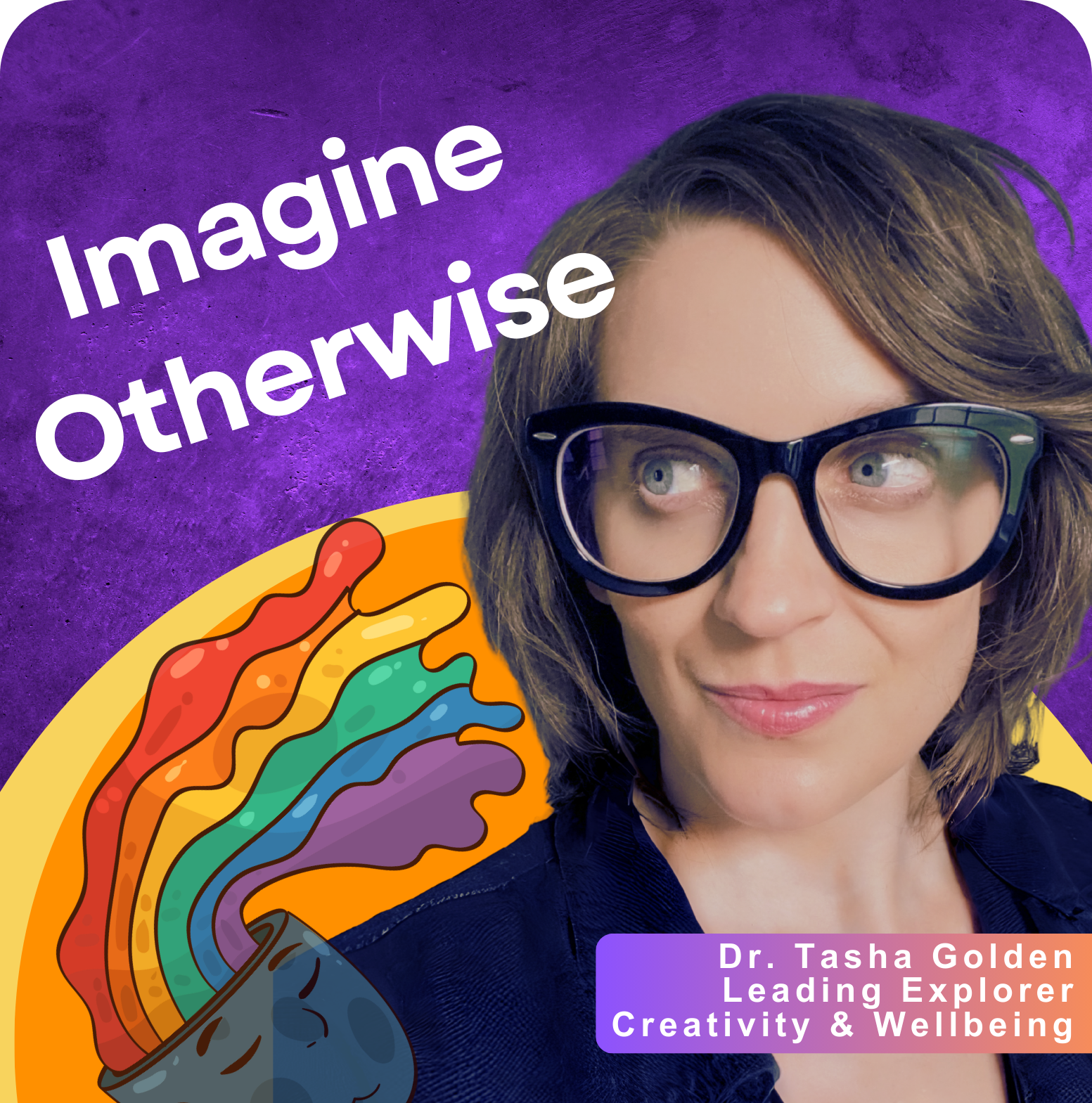
Dr. Tasha Golden is a touring artist turned behavioral scientist who speaks and consults globally on creativity, wellbeing, and change. As the first Director of Research for the International Arts + Mind Lab at Johns Hopkins School of Medicine, Tasha has published extensively on the intersections of arts, behavior, and wellbeing. Named one of Fierce Pharma's "Fierce 50" for integrating arts and healthcare, she helps organizations and individuals combine science and creativity to advance wellbeing, innovation, and impact.
When Dr. Tasha was 11 years old, she disappeared into the woods, writing stories about discoveries and secret passages in haunted houses. Time vanished as she wandered through trees and daydreams, weaving narratives about adventures yet to unfold. That same spirit of exploration—of seeking hidden corridors and imagining what lies beyond the visible—seems to continue to animate her work today, inviting us all to discover the unseen portals within our own lives and communities.
www.tashagolden.com/magicademy
Creative Process
Discuss Potential Outlines: human + ai
Create Initial Drafts & Iterate: human + ai
Guest Alignment Review: Dr. Tasha Golden
Ensure Final Alignment: Dr. Jiani Wu
Initial Publication: Dec 28, 2025
Disclaimer:
AI technologies are harnessed to create initial content derived from genuine conversations. Human re-creation & review are used to ensure accuracy, relevance & quality.
