
Visual Thinking | Temple Grandin
Why it is included:
The "Cognitive Corrective." Grandin argues that society—and our definition of "genius"—is biased toward Verbal Thinkers (linear, word-based).
But a flourishing civilization cannot be built on words alone; it requires Visual Thinkers (object and spatial processors) who can simulate complex systems, bridges, and code in their mind's eye.
We include this to ensure the kit honors the Engineers and Builders.
It reminds leaders that true "Imaginative Courage" requires diverse cognitive teams—blending the poets (who dream the future) with the visualizers (who can see the nuts and bolts required to hold it up).
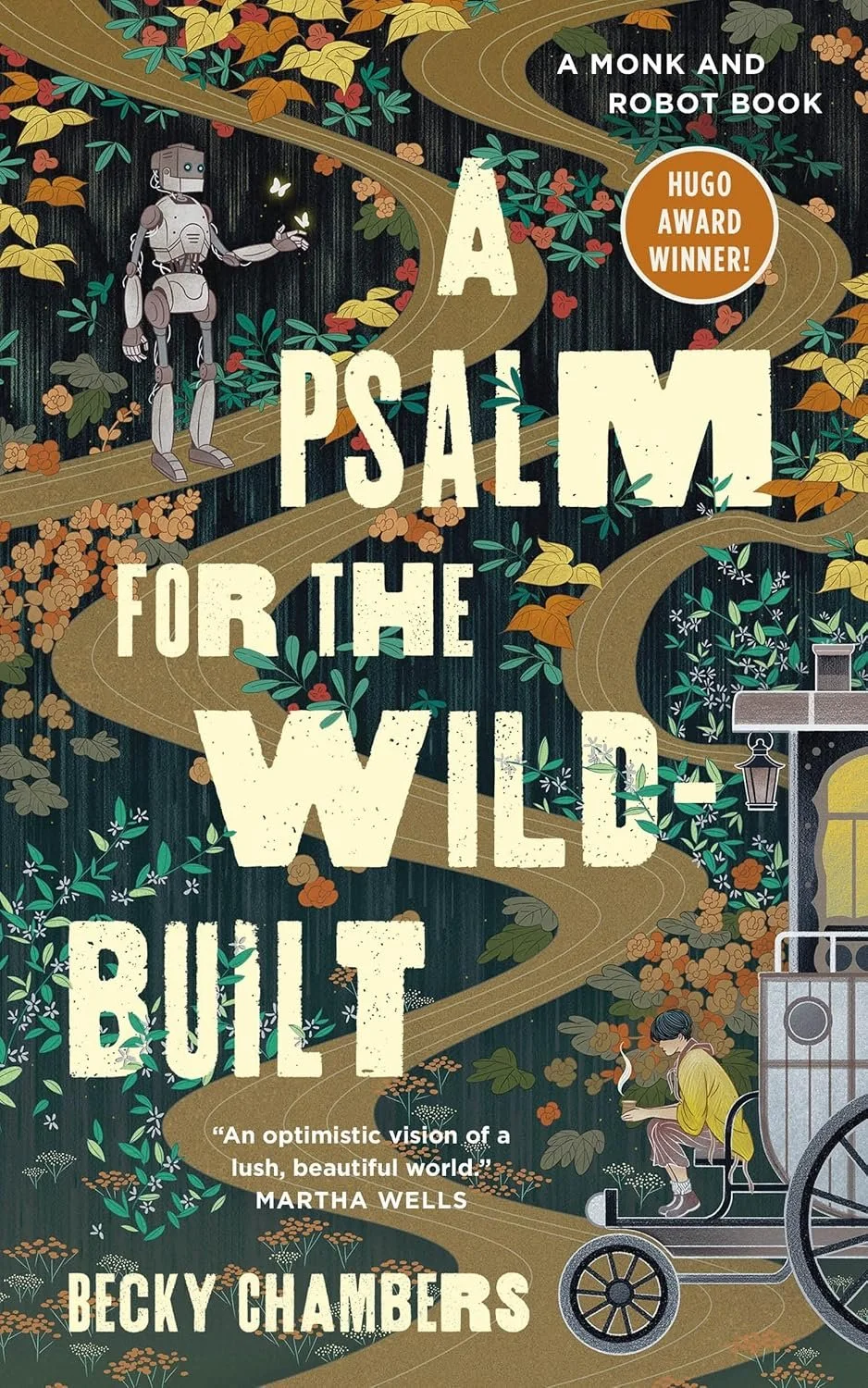
A Psalm for the Wild-Built | Becky Chambers
Why it is included:
This novella offers something that technical blueprints cannot: the sensory experience of a healed world.
While other books in this section focus on the struggle to save the planet, this story takes place after the victory.
It describes a "Solarpunk" future where humanity has solved its environmental crises and lives in a high-tech society that feels as gentle and organic as a forest.
We include it to provide an emotional "North Star."
It proves that a flourishing civilization doesn't have to be cold, sterile, or purely digital.
It gives the reader a tangible feeling of what we are working toward—a life where advanced technology and the natural world support each other in quiet, meaningful harmony.
Co-Intelligence | Ethan Mollick
Why it is included:
The "Synthetic Engine." We cannot talk about the future of creativity without addressing the alien intelligence in the room: Generative AI.
Mollick, a pragmatic Wharton professor, argues that we must treat AI not as a replacement, but as a "Co-Intelligence"—an infinite intern, a sparring partner, and a multiplier of human potential.
This book is the manual for the "Centaur" model of work (Human + Machine).
We include it to ensure the user is equipped with the most powerful creative tool of our time, learning to direct this new intelligence to solve problems that were previously unsolvable by biological brains alone.
Not the End of the World | Hannah Ritchie
Why it is included:
The "Reality Check." In a world drowning in "Doomerism," Hannah Ritchie provides the data to prove that we are already winning.
As the lead researcher at Our World in Data, she presents rigorous evidence that we have decoupled economic growth from carbon emissions and are approaching peak pollution.
We include this to provide the Factual Bedrock for our optimism. It proves that "Imaginative Courage" is not a delusion, but a statistically supported stance.
It transforms sustainability from a moral sacrifice into a solvable engineering problem, giving us the confidence to push through the final mile of the transition.
The Ministry for the Future | Kim Stanley Robinson
Why it is included:
The "Blueprint." This is the most important novel of our decade.
It moves us from "Apocalypse Anxiety" to "Solution Architecture." It invites us to imagine how a flourishing civilization actually governs itself, creates new money (the Carbon Coin), and creates a legal truce with the biosphere.
It is not a utopia; it is a gritty, realistic manual for the transition.
We include it because it restores Agency, proving that the future is not something that happens to us, but something we can actively engineer through bureaucracy, technology, and courage.
Invisible Cities | Italo Calvino
Why it is included:
The "Dream Architecture." In this surrealist masterpiece, Marco Polo describes 55 imaginary cities to Kublai Khan—cities made of webs, memories, and desires.
We include this to ensure our imagination doesn't become purely utilitarian.
A flourishing civilization isn't just about efficient solar grids; it is about creating habitats for the human spirit.
Calvino trains our "Aesthetic Intelligence," teaching us to see cities not just as infrastructure, but as living repositories of human culture and dreams.
It expands the boundaries of what we believe is possible to build.
The Sense of Wonder | Rachel Carson
Why it is included:
The mother of the modern environmental movement argues that for the child—and the adult—"feeling is more important than knowing."
She provides the "Biophilic Anchor," reminding us that we cannot save a world we do not love.
This lyrical manifesto ensures that our "Imaginative Courage" is rooted in a primal, sensory connection to the living Earth.
It is the antidote to the "disenchantment" of the digital age, grounding our future visions in the smell of wet soil and the sound of the ocean.